This unit's project, the second one that is, is converting measurements of food in recipes from standard to metric (SI) units. This project was not really that confusing, and is very relevant to our unit, Matter and Measurements. A useful website I found for turning food measuring units (cups, teaspoons, tablespoons) into grams and liter.
For some of the recipes that I used one of my mothers cookbooks, Better Homes and Gardens. I found the website here.
Thursday, October 29, 2015

Tuesday, October 27, 2015
Dimensional Analysis
Dimensional analysis is basically converting measurements into different units.While I have learned this before in some of my other classes, Mrs. Frankenburg taught it in such a way that it made more sense then some of my other teachers. Sadly I have to remember a lot of the conversions, so that could trip me up on the test on Thursday. I found a website that has most, if not all of the conversion on it.
We also learned about Kelvin today, the temperature that it. Kelvin measures the kinetic energy of particles in a sample. Kelvin was created the Kelvin scale with number of absolute zero (no heat in sample) being equal to zero. Creating a new scale wasn't the only thing that he achieved as seen here.
We also learned about Kelvin today, the temperature that it. Kelvin measures the kinetic energy of particles in a sample. Kelvin was created the Kelvin scale with number of absolute zero (no heat in sample) being equal to zero. Creating a new scale wasn't the only thing that he achieved as seen here.
Friday, October 23, 2015
Moles and Chemisty
A mole is equal to 6.0221415×10²³, that is, in the SI unit of measurement. Chances are you know of moles as little mammals that dig underground, and like in my house, wage war on the front lawn, looking something like this.
Due to a national mole day (yes it's a real thing, there is even a National Mole Day Foundation), my classmates and I made a stuffed animal mole, and Mrs. Frankenburg loved them. While I don't see any real connection to stuffed animals and chemistry, I did get a day off of lecture so I'm not complaining.
Thursday, October 22, 2015
Matter and Measurements
Yesterday we started a new unit, on matter and measurement. For the most part I feel as if I knew a big chunk of this information before starting this, because most of the material so far seems familiar. Some new thing are the heating and cooling curve, more distinct classification of matter (heterogeneous mixture, homogeneous mixture, etc.), and significant figures.
 |
| Heating Cooling Curve |
Significant figures seem confusing to me, and some of the law seem a little pointless. Found a webpage that puts all of the rules and examples in a simple way.
We got a new project that seems relevant to what we are learning, taking measurements of ingredients of meals and putting them into metric. I like how I can easily see the relationship between the project and the unit it was tied to, which I had trouble with in earlier projects.
Thursday, October 8, 2015
Aspirin Lab
Sadly this is not a lab that I will be participating in. Basically it was a high level lab that involves creating aspirin (acetylsalicylic acid), and I understand next to nothing on how this happens. The initial setup looks like this:

This would take chemicals acetic anhydride and salicylic acid and combine them together using the catalyst sulfuric acid. Chemicals are heated up in a hot water bath and then cooled with ice water to induce crystallization. The chemicals are left overnight. The next day the solid aspirin is added to the top of this:
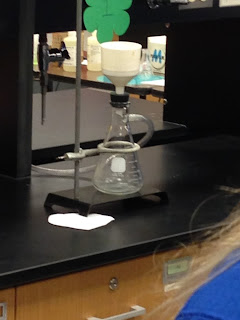
In this section, the crystals are cleaned up of residual. This is were my class would stop, but in the full lab, the aspirin is purified by dissolving the crystals and recrystallizing them.
This lab was higher than mine and my classmates understand at this time, but hopefully I'll understand as the year progresses.

This would take chemicals acetic anhydride and salicylic acid and combine them together using the catalyst sulfuric acid. Chemicals are heated up in a hot water bath and then cooled with ice water to induce crystallization. The chemicals are left overnight. The next day the solid aspirin is added to the top of this:

In this section, the crystals are cleaned up of residual. This is were my class would stop, but in the full lab, the aspirin is purified by dissolving the crystals and recrystallizing them.
This lab was higher than mine and my classmates understand at this time, but hopefully I'll understand as the year progresses.
Wednesday, September 30, 2015
Nuclear Fusion and Fission
Nuclear fusion sound amazing when you think about it. Taking two elements smashing them together to create a new, heavier element sounds like it comes out of a science fiction movie. The fact that it can be used to create energy without the harmful radioactivity, like it can in fission, can mean a lot of green opportunity, and we are closer to this than you might think.
It's also cool that the only place we know of nuclear fusion happening is in a top of a line lab, like this

Nuclear fission, on the other hand, is the spitting of an atom into two lighter ones. And we do this, like a lot. Around 25% of electricity in the U.S. is created with fission, and a lot more in France, around 85%! A fifth of the world energy is provided by nuclear power plants, even though they might have some fundamental problems.
Overall, fission and fusion seems pretty cool, even if it can be dangerous.
Tuesday, September 29, 2015
Forensic Archaeology
In this lab that we were given on Monday my lab partner and I were given a situation where we had to find the half life of imaginary atoms. This was done by using small squares that had a dark side and a white side. 567 squares were put into a cup and randomly poured on the table. The paper squares with the white sides were taken out. This was repeated six times.


When doing this experiment, I started to wonder how often the half life of an object is correct. Is the half life more of average time, or an exact time. By what Mrs. Frankenburg has said, it seems that the half life is always correct. In statistics I've learned about predicted lines, and I think that the lines of a half life graph are probably the predicted lines, but probably a good average due to extensive research on atoms.
Forensic archaeology is the application of archaeology to criminal investigations. Part of archaeology is using the half life to predict the age of something, such as a old human items. The main use of forensic archaeology is to figure out the age of a body, similar to the what we were doing in the lab.
Subscribe to:
Posts (Atom)