Showing posts with label Acids and Bases. Show all posts
Showing posts with label Acids and Bases. Show all posts
Monday, February 15, 2016
Final Thoughts on Acids and Bases
This unit managed to be difficult and simple at the same time. For the most part it made sense and I had no trouble answering any questions thrown at me, but for some of the finer points, it could become increasing difficult. The ICE Box wasn't hard for the most part, but at when the question were mixed around it could be. Overall this unit wasn't extremely difficult and had helped me understand the last unit, solutions, better.

Saturday, February 13, 2016
Post Test Thoughts
Overall, I thought this test was much easier than the last one we took, mainly because the last one was horrific. I get threw about 3/4 of the test without a problem, but then got stuck on a few question. I did have to spend time after class on the test, because I took a while on the last few problems. Despite this, I think I'm going to get a good score on it and feel pretty confident about it.
Wednesday, February 10, 2016
Ice Box

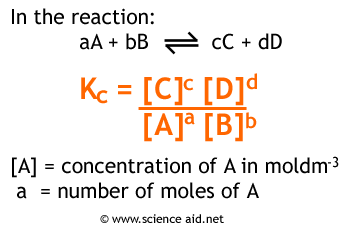
Ice Box is a method for finding the pH of weak acids. Rather than try to explain it, to the right is a picture of one.
The values found on the bottom can be put into an equilibrium expression to solve for x. The x can then be solved to find the pH, or sometimes the Kc value.
Tuesday, February 9, 2016
Titrations
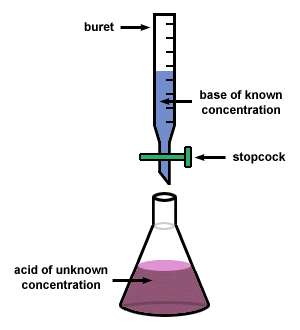
The last two labs we've had have been over titrating an acid with sodium nitrate, to find exactly how much acid is in the solution. Titration works by taking a an acid with an indicator (another solution) and putting a base into it. The base will react with the acid until there is no more acid to react to it, where the base will combine with the indicator, making a color change. The first lab we found how much acetic acid was in vinegar, then the second one was over an unknown acid. In both labs we found a standard (titrating KHP with NaOH3) and use the resulting numbers to find the molarity of the NaOH3, then use that number to calculate the amount of acid.
Saturday, January 30, 2016
Finding pH
Last Friday we learned about how to find the specific pH of an acid or a base. pH tells how acidic/basic a solution is. We found it by taking the hydrogen ion concentration and putting it into an equation.
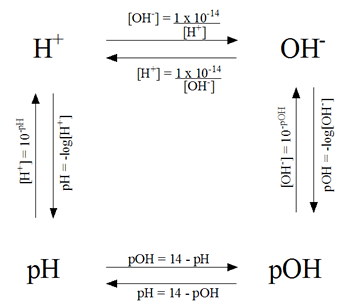
The OH- stands for hydroxide ion, what is normally found in bases. It is possible to know the OH- concentration and finding the pH by using these formulas.

Above is a pH scale that gives a few examples of acidic and basic solutions. Solutions form 0-6.9 are acidic and solutions that are form 7.1 to 14 are basic. Pure water is a neutral solution, which is represented by 7 on the pH scale.
More info and practice:
Interactively shows pH:
Thursday, January 28, 2016
Acid Base Solutions
Yesterday we started a new unit over a different type of solution, acid base. I learned that there are three different models for acid base solutions but we will only learn about two. The first one I knew, it was called Arrhenius acids and bases. Acids have a leading (H+) ion and bases have a (OH-) ion.
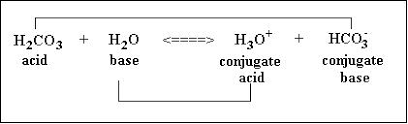
The new one I learned was called Bronsted-Lowery Acids and Bases, where during the solution a (H+) ion leaves the acid and goes and is put into the base. These solutions often in equilibrium, so they can occur both ways.
The new one I learned was called Bronsted-Lowery Acids and Bases, where during the solution a (H+) ion leaves the acid and goes and is put into the base. These solutions often in equilibrium, so they can occur both ways.
The reason the pairing are attached to "conjugate acid/base" means that when the equation is read the other way (right to left) that they are the acid and base.
Confuses? Look here for some more info.
Subscribe to:
Posts (Atom)